
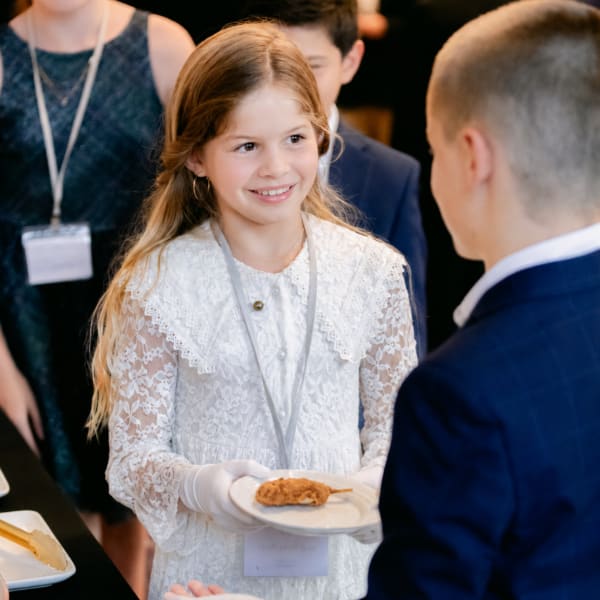
We have been teaching Social Graces — sometimes referred to as etiquette — for nearly 20 years. During that time, we have seen a noticeable shift away from eye contact and basic conversation skills. If the pandemic taught us anything, it is that we are all connected to one another at a very basic level. The only way to build these connections is by developing observation, listening, and conversation skills, which remain the foundation of our program.
At Addington Cotillion, we begin by teaching introductions. For our 3rd graders, this means introducing themselves to classmates or adults. We focus on eye contact, a confident handshake, and speaking their name clearly and loudly.
Our older students learn how to introduce others. This may include introducing their parents to a teacher or introducing two friends to one another. As the season progresses, students also learn conversation starters to help move past the awkward pause that can occur after names are exchanged.
Next, we teach Personal Presence and Party Protocol. A Princeton study found that 70% of a first impression is based on visual cues, so we focus on the signals others use to form assumptions about us. Grooming, posture, and body language all influence how others perceive us.
Our 3rd graders practice posture by walking with stacked plates balanced on their heads. Older students advance to walking with the plates while the young gentleman escorts the young lady. As the saying goes, “You never have a second chance to make a good first impression,” so we encourage students to make it count.
We also cover guest and host responsibilities, including:
Being respectful in others’ homes and public places
Using inside voices
Avoiding running indoors
Leaving a space at least as nice as you found it
Writing thoughtful thank-you notes
Understanding the importance of RSVPs
We then move on to tie tying. While less common today, it is still an important skill for many of life’s milestone events. Students learn the Half Windsor knot, one of the most versatile and widely used styles. Young ladies and gentlemen alike receive individual instruction on the process of tying a tie.
Life sometimes requires us to communicate remotely. In this session, students learn how to conduct meaningful conversations through open-ended questions, active listening, and observation skills. They also learn how to recognize when others — or they themselves — are ready to disengage from a conversation.
The ability to show genuine interest in others is one of the key elements of appearing “charming,” because people naturally enjoy talking about themselves and feeling heard.
At the conclusion of the season, we bring everything together with a comprehensive review. Each group is quizzed to help reinforce and measure what they have learned throughout the year.
In addition, we teach young gentlemen to look after the young ladies by:
Escorting
Introducing them to the Patron in the receiving line
Serving them at the refreshment table
Carrying on polite conversation
This practice of thinking of others before themselves develops beautifully over the two to three years many students attend cotillion. It is a skill that proves valuable not only in social settings, but also in both personal and professional life.